|
| Massachusetts Republican Senate nominee Gabriel Gomez campaigns in Shrewsbury, MA in February, prior to his 15 point primary win last Tuesday. Photo courtesy of AP/Winslow Townson |
Fortuanately for Republicans, early polling on the race had indicated that of all the possible match-ups for the special election, a Gomez vs. Markey battle would be the most competitive. Gomez (R) performed better than Sullivan or Winslow in all pre-primary polling against Markey OR Lynch, while Lynch performed stronger against all 3 potential GOP opponents than Markey. So in terms of all the different potential match-ups, the Republicans lucked out, as a new Public Policy Polling (D) survey confirms:
The candidate for US Senate are Republican Gabriel Gomez and Democrat Ed Markey. If the election was today, who would you vote for?
Ed Markey (D) - 44%
Gabriel Gomez (R) - 40%
Undecided - 16%
Prior to his primary win, Gomez had trailed Markey by 15 and 19 points. Since his win, two polls have shown the race within at least 6 points, WNEU and now, PPP.
In the special election three years ago, loser Martha Coakley (D) never relinquished her lead over eventual winner Scott Brown (R) until about 2 weeks before the actual election. This year's election is still 6 weeks away. So obviously, things look pretty good at the moment for Gabriel Gomez. He's starting ahead of where Scott Brown was in polling at this point in 2010, and has ample time to move ahead of Markey (or perhaps, move further behind).
The two most recent, non-presidential-electorates in Massachusetts took place in 2010. Scott Brown defeated Martha Coakley (D) 52-47% that January, while Gov. Deval Patrick (D) won reelection against Charlie Baker (R) and Tim Cahill (Independent) 48-42-8%.
How does the 2013 special election electorate compare to the one that catapulted Brown to victory in January 2010, and the one that helped Patrick survive for a 2nd term that November? They're similar in some, but not all ways.
For example, consider the racial identification PPP gound in the 2013 Senate poll:
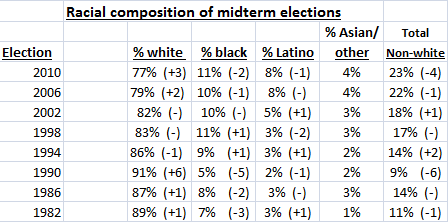
 |
| Information compiled from 2010 Brown v. Coakley exit polling, 2010 Patrick v. Baker v. Cahill exit polling, and 2006 exit polling. |