Showing posts with label Bob McDonnell. Show all posts

Friday, May 31, 2013

It's Public Policy Polling vs. The World With Regards to Gov. Bob McDonnell's Approval Ratings

Public Policy Polling stands out among polling firms for their partisan, often times combative nature.


In the Virginia Governor poll released by PPP yesterday, and referenced by this blog, there was an easily missed statistic regarding the job approval rating for Virginia's Governor. According to the Democratic leaning pollster, Bob McDonnell (R) is above water with Virginia voters, but only somewhat:
Do you approve or disapprove of Gov. Bob McDonnell's job performance? (May 24-26, 2014; 672 Virginia voters, 3.8% MoE)

Approve  -  44%
Disapprove  -  37%
Not Sure  -  19%

This finding represents a net 6 point deterioration in approval for McDonnell's job performance since PPP's last poll in January (48/35%), and represents their lowest net rating for the Governor since July of 2012. But more significantly, the above finding represents a fairly significant departure from every other pollster to test the Virginia Governor's job approval this year, or even since taking office in 2010.

Just consider Quinnipiac University, which released a survey on Bob McDonnell's job approval rating less than two weeks before PPP. They found McDonnell's overall net job approval rating to be 3 TIMES higher than PPP (49/28% vs. 44/37%), while his rating among whites was DOUBLE PPP's finding (50/29% vs. 48/36%). Meanwhile, there's an astounding 30 point spread between Independents' views on Gov. McDonnell's job performance (54/27% per Quinnipiac, and 39/41% per PPP).

But there's no need to stop at Quinnipiac. Just 3 weeks ago, the Washington Post released a survey showing McDonnell with a net job approval rating 5 TIMES higher than PPP just found. And the same week, NBC/Marist found the same thing, as the chart below of McDonnell's job approval rating since the start of this year notes:


McDonnell's lowest rating this year besides PPP's most recent survey came in January, when he hit 48/35%, from none other than....PPP. Every other polling firm this year has found McDonnell between +21 and +37 in terms of net job approval/disapproval.

And the outlier-nature of PPP's Virginia Governor job ratings doesn't end with just this year:

Thursday, May 30, 2013

2009 VA Gov Electorate Voted 51-43% for McCain; PPP finds 2013 Electorate Giving 45% to Romney

John McCain, seen here with Va. Gov. Bob McDonnell in Oct. '09, wound up being a valuable asset to the campaign. Of the Virginians that voted on election day '09, 51% said they supported him in '08. Photo courtesy of Preston Gannaway & The Virginian-Pilot
Yesterday, Public Policy Polling released their second Virginia Governor poll of the year, with very little changed from the last survey in January. Terry McAuliffe (D) maintains his 5 point lead over Ken Cuccinelli (42-37%), while McAuliffe's net favorability rating fell slightly, and Cuccinelli's rose slightly. Oh, and in a rare move, the number of undecided voters actually increased from 13% to 21% since the last survey 5 months ago.

At the same time, PPP finds the Virginia electorate remains largely unchanged as well. Five months ago, Democrats held a 3 point partisan identification advantage (35% Dem, 32% Rep, 32% Ind), which is now down to one point (34% Dem, 33% Rep, 33% Ind). The racial identification findings from January and now are virtually identical (74% white, 18% black, 8% other), as well as ideological I.D., age I.D., gender, and '2012 vote'.

But how does the PPP electorate compare to the one found by exit polls in 2009, when Republican Bob McDonnell defeated Democrat Creigh Deeds in a landslide?

In most ways, it's similar, with one big exception.

White voters comprised a slightly larger slice of the electorate in '09 (78%) than what PPP finds now (74%), but not enough to significantly alter the poll results. The 2009 race featured an R+4 party I.D., while PPP finds D+1 (again, the difference is not enough to substantially change the survey result if reweighted). PPP also finds a larger gender turnout gap than seen in 2009, as well as a slightly older electorate, but nothing that would change the fundamentals of their topline.

The one exception to the above paragraph can be seen in the crosstab regarding the 2012 vote. Often times, pollsters will ask respondents who they voted for in the previous presidential election, mostly to get an idea of how the pool of survey takers compares to the prior presidential electorate (this question was frequently used in survey analysis in the run-up to the South Carolina 1st Congressional District special election between Mark Sanford and Elizabeth Colbert-Busch to gain insight into the strength of GOP turnout).

As has been noted here before, off-year, non-presidential races have a tendency (though not always) to attract less Democratic friendly electorates than in presidential years (see the 2010 vs. 2008 general election exit polls). But that is not the case in either of PPP's Virginia Governor polls. In both surveys, 49% of respondents say they voted for Barack Obama in 2012, while 45% claim they supported Mitt Romney. 6% say they supported someone else, or do not remember. That's an identical margin to the actual result in Virginia last November, when Obama carried the state 51-47%.

Tuesday, April 16, 2013

Coattail Effect: How far can a Governor's job approval carry his or her party's presidential nominee?

Governor Bob McDonnell (R) (left) has an enviable 51/29% job approval rating back home in Virginia, yet the Republican candidate for President lost to the President by 3 points. Meanwhile, Wisconsin GOP Governor Scott Walker (right) had a decent 51/46% job rating, yet Romney lost his state by 7 points.
Virginia Governor Bob McDonnell became one of the most prolific campaign surrogates in the 2012 election, crisscrossing the country on Mitt Romney's behalf. Not only was he a popular home-state Governor, but he just happened to be the chief executive of one of the most hotly contested swing-states in the nation. That's a helpful combination to have around. While popular Republican governor's like Chris Christie and Susana Martinez were good faces to have associated with the Romney campaign, their home-states of New Jersey and New Mexico were never really in contention. They didn't pack the same one-two punch of Virginia's Bob McDonnell.

Obviously, there's a reason we seldom saw or heard of Florida Governor Rick Scott barnstorming across the state with Mitt Romney, or Pennsylvania Governor Tom Corbett holding local town-halls with Paul Ryan. Both of them averaged 39/45% and 35/46% job approval/disapproval ratings respectively in the final two months of the campaign.

But does the actual evidence suggest that a Governor's job approval/disapproval rating can affect Presidential election results on a state level? Unfortunately, the data is not terribly clear.
The table below contains a lot of information, so let's break it down piece by piece. It compares the job approval/disapproval ratings for every U.S. governor over the final two months of the 2012 Presidential campaign to actual election results, as well as actual election results to Obama/Romney's favorable/unfavorable ratings. In order for a particular state Governor to be included in the chart, he or she must have had at least one job approval assessment in the September and October before the election. That's why a few Governors, like Alabama, Mississppi, Wyoming, etc are missing. Red entries indicate either a Republican Governor, a Republican election win, or a net state-based positive favorability rating for Mitt Romney in the presidential election. Likewise, blue entries indicate Democratic Governors, a Democratic election win, or a net state-based positive favorability rating for Barack Obama. Since exit polling was only conducted in 31 states in 2012, not every state will include an Obama/Romney favorability assessment. Polling information was compiled from tpm poll tracker, pollster, and various internet searches:

For an easier to read, larger version of the above table, click here.

Of the top 10 most popular Governors in the country (based on polling averages taken from September 1-November 6 2012), 5 were Democrats, and 5 were Republicans, in 5 blue states, and 5 red states. Of the 10 least popular, 5 were Democrats, 4 Republicans, and 1 liberal Independent, in 9 blue states, and 1 red state. This stat seems to suggest red-state residents (those states that voted for Romney in the last election) tend to be bigger fans of their Governors (whether they be Democrats or Republicans) than blue state residents.

Saturday, March 30, 2013

Shorter Quinnipiac poll: If Ken Cuccinelli is too partisan or extreme for Virginia, someone forgot to tell the voters.

Courtesy of Greg Skidmore
Virginia Attorney General Ken Cuccinelli has been on the receiving end of attacks from the right and left regarding his viability as a 2013 gubernatorial candidate. Democrats think he's a dangerous ideologue who will place purity to the conservative cause above the well-being of citizens of the Commonwealth. Some Republicans, especially Jennifer Rubin of the Washington Post, think he's a weak candidate who is running a low-key at best, inept at worst campaign.

But if the somewhat limited polling on the 2013 Virginia Governor's race to date is any indication, Virginia voters are either unaware that the man they call the "Cooch" is a brash ideologue headed for certain defeat, or are willing to support him regardless.

Take for example the recent Quinnipiac University poll on the 2013 Virginia Governor's race. Cuccinelli leads Terry McAuliffe 40-38%, his first lead in any Quinnipiac poll of the race to date. But the better news for Cuccinelli lies in the trend lines. In Quinnipiac's first survey of the race in November of last year, McAuliffe (D) led Cuccinelli by four points. In the follow-up poll from January, his lead had dropped to 1 point. In February, the two were TIED, and last week, Cooch grabbed his first lead. He also leads McAuliffe among Independents by 37-29%, and sports a +6% overall favorability rating with all Virginia voters (34/20%), though a large plurality don't yet have an opinion on their attorney general (46%). McAuliffe is at +4%, with a whopping 63% who are unsure.

By only 5 points, Virginians say Terry McAuliffe has the right kind of experience to be Governor, while voters say the same of Cuccinelli by 20 points.  And despite all the talk of Ken being an ideologue, a slight plurality of voters say his ideology is "about right," while just 29% say he is "too conservative." For what it's worth, that's the same percentage that say McAuliffe is "too liberal."
Even more so, Virginians approve of the job their attorney general is doing by a large margin, 45/27%. Pretty impressive for a conservative firebrand in a blueish-purple state.  His job approval rating has a higher net margin than that of newly elected Democratic Senator Tim Kaine (47/33%), and only slightly behind Sen. Mark Warner (D) (56/26%), and Gov. Bob McDonnell (53/26%) . That high job approval rating, if it stays there throughout the campaign, could translate into vital support this November.

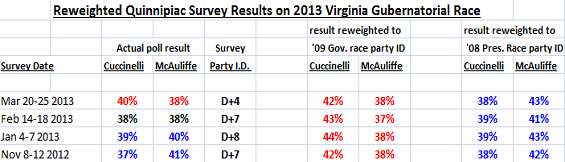
The Cuccinelli camp can find further reassurance in the Quinnipiac cross-tabs on partisan identification. Survey respondents identified as 30% Democrat, 26% Republican, and 35% independent, a good deal less Republican than partisan self-identification in the 2009 Governor's race (37% Republican, 33% Democrat, 30% Independent). Had the Quinnipiac survey found party I.D. to be the same as November 2009, all other findings remaining the same, Cuccinelli would take a larger 42-38% lead.

The chart below compares actual Quinnipiac findings to reweighted partisan identifications: the 2009 Governor's race and the 2012 presidential race. This should provide us with a sort of partisan I.D. floor and ceiling, as Republicans are unlikely to see better than R+4 turnout in November, and Democrats are unlikely to see better than D+7 (party ID in VA. in the last presidential election):


Obviously, if the November 2013 Virginia electorate resembles 2009's electorate, Ken Cuccinelli will likely have a good election night. But if it looks anything like it it did in the presidential election last November, the former head of the Democratic National Committee will likely be Governor.

Which electorate are we likely to see? It's hard to say, but it's probably smarter to compare the upcoming gubernatorial electorate to the last gubernatorial race, given that Obama won't be on the ticket when voters head to the polls in 7 months.

...One final note regarding Cuccinelli's current standing in polls against McAuliffe: he's not doing that much worse than Bob McDonnell at this approximate stage in the 2009 Governor's race. And he went on to win his race by a landslide. The chart below compiles every poll taken on the 2013 Governor's race to date, courtesy of TPM poll tracker, Pollster, and Real Clear Politics:

Monday, January 21, 2013

Popular as he may be, Gov. McDonnell would struggle in future statewide races, per PPP


Virginia Governor Bob McDonnell (R) has been polled twice by two major polling companies at this early stage in 2013, and both find Virginians APPROVING of his job performance by large margins. Yet despite his strong standing with voters, he would struggle in a 2014 Senate race, or a 2016 presidential race, according to Public Policy Polling.

Quinnipiac University's survey indicated that Gov. McDonnell emerged from the 2012 Presidential race with his best net job approval rating since December of 2011, with 54% of Virginians expressing approval of the job he is doing, while just 27% express disapproval. Public Policy Polling was in the field one week earlier than Quinnipiac, and found McDonnell sporting an impressive 48/35% job approval/disapproval rating, though notably less impressive than Quinnipiac. In fact, as the chart below indicates, Governor McDonnell has maintained stellar approval ratings throughout his entire term in office (which doesn't expire until January 2014), averaging 55/30% across 51 polls over the last 3 years:


Two of the four most frequent pollsters in Virginia  diverged somewhat from the average, with PPP tending to show McDonnell MUCH less popular than Quinnipiac's average, Rasmussen's average, AND Roanoke's average. In fact, Bob McDonnell only manages a +11 average job rating from PPP (46/35%), as compared to the +25 rating from the average of all polls (55/30%).

Thursday, January 10, 2013

2013 Virginia Governor: PPP paints bleak picture for the Cooch (R). Quinnipiac? Not so bleak.

From left, Cuccinelli, Gov. McDonnell, & Lt. Gov. Bolling after their win in 2009. Oddly enough, the man on McDonnell's left has said he would not be on a ticket with the man on McDonnell's right.

Public Policy Polling released their first poll on the 2013 Virginia Governor's race yesterday, and the results weren't great for likely Republican nominee, Ken Cuccinelli. The former Attorney General only  managed to garner 41% against his probable opponent, failed 2009 Democratic candidate and Clinton-confidant, Terry McAuliffe (who managed 46% in the PPP poll). This result closely mirrors a Quinnipiac poll from November that showed McAuliffe up 41-37%.

Diving into the poll internals, the news only seems to get worse for Cuccinelli. For an example, take a look at the ideological identification of the poll respondents. Virginia voters identify as 27% Liberal, 32% Moderate, and 41% Conservative. Compare this to the exit polls for the 2009 Virginia Governor's race, which saw just 17% Liberal turnout, 42% Moderate, and 40% Conservative. Despite Liberal turnout being much lower in 2009 than the 2013 PPP finding, Cuccinelli would still trail McAuliffe by the same margin if the PPP poll were reweighted to 2009 ideological turnout. See the math in the chart below:


PPP survey weighted to 2009 VA Gov ideological I.D.


How, exactly, is it that Cuccinelli (R) still trails McAuliffe (D) 46-41%, despite reweighting the numbers to a LESS liberal ideological make-up? Because regardless of the drop-off in liberals, moderates were a much larger percentage of the 2009 electorate than what PPP found in their poll. And unfortunately for Cuccinelli, the Republican trails the Democrat among moderates by a substantial, 61-25% margin. That was NOT the case in the 2009 gubernatorial race between Gov. McDonnell (R) and Creigh Deeds (D), when the Democrat carried moderates by a much narrower 53-47% margin. That difference in the performance of Cuccinelli and McDonnell among moderates is the main reason the Republican does just as poorly whether the numbers are weighted to the PPP ideological finding, or the 2009 ideological finding. IF, somehow, the Cooch were able to get 47% of the Moderate vote (as McDonnell did in '09), HE would lead the PPP poll, 51-42%, a 14 pt reversal from the actual PPP result.

Still, the PPP poll is rough for the Virginia Republican. Even IF Cuccinelli were lucky enough to see low liberal turnout like 2009, he'd trail in the PPP poll 46-41%. But it's worth noting that while the PPP ideological I.D. finding is more liberal than the 2009 VA electorate, the 2012 electorate was much LESS conservative. Conservatives made up 41% of the respondents in the PPP poll, 40% of actual 2009 voters, but just 31% of actual 2012 voters. If PPP is right, and 2013 turnout sees low conservative turnout like 2012, Terry McAuliffe (D) has the potential to win big:

Thursday, November 29, 2012

2013 VA. Gov: With Warner (D) & Bolling (R) out, looks like McAuliffe (D) vs. Cuccinelli (R)


Quinnipiac released a 2013 Virginia Governor's poll on November 14th, showing tight races between the presumed Democratic nominee Terry McAuliffe and his two likely Republican opponents, Bill Bolling and Ken Cuccinelli. Though with Bolling indicating yesterday he would not seek the Republican nomination for Governor (and Mark Warner indicating the same), the race seems all but set between McAuliffe and Cuccinelli. McAuliffe was an unsuccessful candidate in the 2009 Democratic primary for Governor, and lost to Creigh Deeds (D) (50-26%), the man who eventually went on to lose to Gov. McDonnell (R) in the general election, 59-41%. Ken Cuccinelli is the state attorney general who earned the reputation among Democrats as a Republican boogey man by filing suit on behalf of his state against Obamacare. This tweet from NBC's Chuck Todd sums up insiders view of a potential McAuliffe / Cuccinelli match-up: