Showing posts with label Republican Presidential Primary 2016. Show all posts

Friday, February 19, 2016

Post-New Hampshire Primary Polling Suggests Trump's Historically Well Positioned To Capture GOP Nomination

Photos, from left to right, courtesy of Getty Images, Carlos Osorio/AP, and Mike Segar/Reuters

To the chagrin of the sixty-to-seventy-odd percent of Republicans who do not support Donald Trump as their nominee for president, the billionaire firebrand is looking mighty dominant in post-New Hampshire primary polling. But how is he standing up compared to past polling front-runners at this point in the campaign? For Trump critics, the news is pretty bleak, yet not without at least a faint glint of hope.

In my experience, it's always best to start with the bad news, so here goes:  in nearly every presidential primary since 1976, the national polling leader between the New Hampshire and South Carolina primaries has gone on to become their party's nominee. Specifically, of the fifteen post-New Hampshire national primary polling leaders examined over the last forty years, twelve eventually earned their party's nomination (or 80% of the time).

Having said that, Donald Trump is currently the Republican's national polling leader, and by a wide margin. With one day remaining until South Carolinians head to the polls, Trump's averaging 36% support from Republicans across seven primary surveys conducted after the New Hampshire primary, reaching as high as 41% and as low as 26%. He maintains an average seventeen point advantage over his next closest competitor, Ted Cruz.

Faced with the numbers, and what we know of history, what else is there to conclude other than the fact that Trump appears headed for the Republican nomination?

Tuesday, July 14, 2015

Newsflash: Donald Trump's Poll Numbers Are Brutal, But That's Nothing New

Donald Trump peaked in 2011 national GOP primary polling at 26%. His best performance this year is 16%. Photo courtesy of Charlie Leight/2015 Getty Images.

Much to the chagrin of a large number of right-leaning political pundits, business mogul Donald Trump is polling well enough nationally among Republican primary voters to land himself in the top tier of candidates, whether the so-called "Establishment" likes it or not.

Yes. With one of the most crowded primary fields in history, as well as one of the most hyped, it's the notoriously bombastic and combative Donald Trump who is surging among the GOP.  And as surprising as it may seem, it shouldn't be. After all, we've been down this road before.

Very little has changed in the last 30 years since The Donald first gave serious consideration to a presidential run. Everything is there: the ego, the far-fetched policy prescriptions, the exceedingly wild accusations and insults hurled against his opponents, the erratic behavior, but most relevant to this piece, his poor standing in American public opinion throughout the years.

Polling data from Trump's presidential flirtations before 2011 is hard to come by. Though the limited amount I could retrieve indicated America's patience with Trump was only slightly higher than it is today.

As a result, the focus of this piece will be the comparison between Trump's polling performance in the first half of 2011, versus his performance so far this year. Spoiler alert: from a GOP horse-race perspective, Trump is looking very similar to how he did four years ago. His standing has worsened, however, from three different perspectives: 1) he's less popular with the general public, 2) he's less popular with primary voters, and 3) his general election standing looks worse.


No Love For Trump From The American Public

Since the start of this year, Trump has averaged a 27% favorability rating across nine state and national polls, with 62% saying they view him unfavorably. In national polling alone, he fairs even worse, averaging a 25/65% rating. An ABC/Washington Post survey taken shortly after Trump revealed he would be making a major campaign announcement on June 16 found an astounding 76% of registered voters saying they viewed Trump unfavorably. The same poll found that only 13% of voters could bring themselves to say they view Trump favorably, despite his near universal name recognition. His unfavorable rating exceeds his favorable rating in every poll of adults taken this year, by anywhere from 19-63 percentage points.


Tuesday, June 30, 2015

Jeb vs. George: A Comparison Of The Bush Brothers' Pre-Primary Polling

Barbara Bush recently quipped that Jeb was not her favorite son. If pre-primary polling is any indication, he isn't America's favorite Bush, either. Photo courtesy of Eric Draper/AP.

Jeb Bush received welcome news last week from an NBC/WSJ poll finding him not only sitting atop the 2016 field in the Republican Primary, but the candidate most Republicans can see themselves supporting in the nominating contest. He's the strongest of three Republicans tested in a general election battle against likely opponent Hillary Clinton.

Great news for Bush diehards, right? Eh, it depends on who you are comparing him to. And if it's his brother, the news isn't so great.

George W. Bush led his likely Democratic opponent in the June 1999 NBC/WSJ poll by a significant 51-35% margin (according to Roper's iPoll database). Jeb actually trails his likely Democratic opponent 48-40%.

George W. also led his Republican primary opponents with a Hillary-esque 61% of the vote in the June 1999 NBC/WSJ poll. Elizabeth Dole was in a distant second at 11%. Jeb Bush attracts just 22%, and is within the margin of error of the second, third, and fourth place finishers.

Other pollsters during the same time period found George W. Bush hugely popular not just with Republicans, but with the general public overall. Jeb Bush is viewed unfavorably by more American adults than view him favorably, not to mention his relatively tepid ratings among members of the Republican base:

*YouGov/Economist poll numbers represent a monthly average of their weekly tracking poll.

Thursday, March 12, 2015

Operation Chaos Part Two? What The Lack Of A 2016 Democratic Primary Could Mean For The Republican Contest

These two men may not share much in common, but both were the prime beneficiaries of independent and Democratic votes in their respective Republican presidential primary bids. Photo courtesy of AP/Dennis Cook.

A recent piece featured in U.S. News & World Report by The Run 2016 founder Dave Catanese briefly examined the effects of a non-existent Democratic Presidential primary on a competitive GOP nominating contest.  His focus was New Hampshire, where self-identified independents make up a larger than average share of both the Republican and Democratic electorates. Catanese's suggestion is that with Clinton virtually clearing the Democratic field, the Granite State's independent base will flock to the Republican primary.

Exit polling indicates Catanese is correct. In 2008, when both political parties were deep in the throes of competitive contests, self-identified independents and Democrats made up 39% of New Hampshire Republican Primary voters. Four years later, with President Obama running unopposed on the Democratic side, independents and Democrats, as a percentage of voters, jumped twelve points to 51%.

To be fair, this anomaly isn't limited solely to the Granite State. In Iowa, independents and Democrats jumped from just 14% of GOP caucus-goers in 2008 (when both Republican and Democratic primaries were competitive), to 25% in 2012 (when Obama ran unopposed).

The number of non-Republicans voting in the GOP nominating contest increased from 2008 in sixteen of the twenty states that conducted exit polling in 2012, or 80% of the time.

Why the sharp increase? Absent a uniform national 'open primary' movement, the lack of a competitive primary on the Democratic side seems like the obvious culprit.

Based on data compiled from the twenty-seven states to feature an exit poll in the 2008 GOP primary, and final vote counts provided by Dave Leip's US Election Atlas, self-identified Republicans made up 76% of the Republican primary electorate, independents made up 20%, and Democrats made up 3%. All total, those who identified as something other than a Republican made up 24% of the national electorate.


In 2012, with all eyes on the GOP contest, Republicans dropped to just 70% of the primary electorate, versus 26% who identified as independent, and 5% who identified as a Democrat. That's a total of 30% of GOP primary voters who identified themselves as something other than a Republican. Again, these numbers are based on the twenty-states that conducted exit polling in the 2012 GOP primary.


Red cells highlight states where self-identified Republicans failed to make up more than a majority of the electorate.


Sunday, December 28, 2014

Chris Christie's Republican Problem: A Year Of Scandal Damages His Ratings With An Already Suspicious Base

Chris Christie is the least popular Republican in the 2016 primary field, and that's according to Republicans. Jeb Bush and Mitt Romney are both popular with the base. Center illustration is courtesy of Daniel Adel. Illustration on the left is courtesy of Ismael Roldan. Illustration on the right is courtesy of DonkeyHotey.


In a July 2013 piece written on this blog, I suggested that a bipartisanly popular Governor Chris Christie would likely have a harder time winning a GOP primary than all three of his recent predecessors, Mitt Romney, John McCain, and George W. Bush. The hypothesis was based on an examination of all four politician's favorability ratings with members of their own party in the lead-up to the presidential primary.

Some, myself included, were surprised to learn that, despite home-state rockstar status in the wake of his handling of the Hurricane Sandy recovery, and a national favorability rating in the positive double-digits with voters of all stripes, Christie was in a worse position with his own party than known moderates that ran for President before him.

Flash-forward eighteen months to present day, and the situation has only gotten worse for Governor Christie. Not only did the Bridgegate scandal cause his home-state favorability rating to tumble hard back to earth, but his image has suffered nationally as well. No longer are Democrats giving him the benefit of the doubt - he's essentially any old Republican to them now. Independents, the group among whom Christie often saw his best numbers, now barely keep him above water.

But most important for his lingering presidential run, Christie is in a dangerously perilous position with the people he needs to win a primary - Republicans. In fact, his position is considerably worse than any one of the large pool of potential contenders bantered about by pundits. It's also considerably worse than serious contenders from years past, such as Mitt Romney, John McCain, and Rudy Giuliani.

Christie's trouble couldn't be more apparent than in a recent Monmouth University Poll of fifteen possible Republican presidential candidates. He ranks second-to-last in terms of net favorability, beating out Indiana Gov. Mike Pence (who only 23% of Republicans are familiar enough with to rate at all; Christie, meanwhile, is the second best-known of the fifteen candidates tested, behind Mitt Romney).

Tuesday, September 2, 2014

Like Father, Like Son? Rand Paul Takes A Hit Among Republicans, as Americans Grow More Hawkish on ISIS

After riding high for a while, Rand Paul's primary numbers return to mediocre in the wake of renewed interest in international affairs.

Former Congressman Ron Paul ran twice for President, and never attracted more than 11% of Republican primary voters nationally. He never won a single contest, in either 2008 or 2012. His best statewide performance came in the form of a caucus, in the small state of Maine, where he won just 36% of the vote, losing to Mitt Romney with 38%.

This poor performance shouldn't come as too much of a surprise, especially considering the senior Paul was never your typical Republican primary candidate for President (being a renowned isolationist and 9/11 truther).

Unfortunately for Dr. Paul's son, Rand, the political atmosphere in which he is likely to launch a 2016 presidential bid promises to be more foreign policy focused than the two his father ran in. And Rand has done very little to distance himself from his father's controversial views on international affairs, even as Americans, and particularly Republicans, become more willing to get involved in the festering situation in Iraq.

Perhaps it's a coincidence, but it just so happens that as American awareness of ISIS and the dangers they pose at home and abroad rises, Sen. Rand Paul's GOP primary numbers suffer. It has been over one year since I wrote about Senator Rand Paul's initial rise among Republican voters, in the wake of an old-fashioned filibuster that lit up social media. But his standing has deteriorated since then. Consider the chart below, which documents every national or state Republican presidential primary poll taken since the end of June (when the first national surveys on Americans' views towards ISIS began appearing):

Thursday, July 31, 2014

Reviving Rick Perry - The Master of Debate Debacles Is Back On Top After A 3-Year Repentance

Photo courtesy of Joyce Marshall/AP


It was the 'oops' heard 'round the world. A painstakingly demeaning moment in front of millions of TV viewers nationwide turned Texas Governor Rick Perry's 2012 Presidential campaign upside down. Perry, who entered the field later than any contender, needed to make a good impression on voters just tuning into the race. Instead, he reenforced preconceived notions. Like the fact that he was an intellectual lightweight, an accusation hurled often at ex-President George W. Bush. And who could blame anyone for buying into those stereotypes? It's not as if Perry was trapped in a 'gotcha moment' by the debate moderator. He was hoisted by his own petard (thanks Selina!), unable to complete his own talking point on the three federal agencies he would abolish as President.

Needless to say, the "oops" moment was a low point for the Perry campaign. He quickly fell into single digits in national polling and never recovered, having made a huge splash upon his late entry into the race on August 13, 2011. Before the "oops" debate on November 9, 2011, Perry averaged 19% in national Republican primary polls. After that debate, until he suspended his campaign on Jan 19, 2012, he only averaged 7%. See the table below:


Polling data used in averages is compiled from The Roper Center's i-poll database.


Thoroughly mocked and humiliated on a national level, Perry returned home to finish out the three remaining years of his fourth term as governor. And not even they were happy to see him.

If "oops" was Perry's low moment, then his best moment since then would certainly have to be now. After the failure that was 2012, Perry set out to rekindle relationships and reassure potential supporters that 2016 would be much more serious. And external political events, namely the crisis of unaccompanied immigrant children flooding the southern border, have further boosted his profile. All of this has culminated in the two most recent national 2016 GOP primary surveys finding Perry essentially tied for first place.

A recent Fox News poll finds that while several potential candidates are clustered together at the top, Rick Perry and Jeb Bush emerge with 12% a piece, more than anyone else. A CNN poll released just a couple of days earlier found Perry again in double digits amidst a crowded field, with 11%. Chris Christie and Rand Paul led with 13% and 12%, putting Perry well within the +/- 4.5% margin of error.

Yet perhaps more important than Perry's raw percentage of the likely 2016 Republican primary vote are the trend lines. In the case of the Fox News poll, Perry drastically improved his performance from their prior survey in April, where he only managed 5% of the vote (good enough for 6th place). In the CNN survey, Perry nearly doubled his level of support from their prior poll just two months ago, jumping from 7th to 3rd place.

Thursday, February 20, 2014

The Predictive Power of (Very) Early Presidential Primary Polling Part V - 1980 & 2012 Republican Primaries

Ronald Reagan and Gerald Ford were interparty rivals for two consecutive primary cycles. Ford won their first encounter. The two were essentially tied in early 1980 GOP primary polling, until Ford announced he would not run for President a second time. Photograph by David Kennerly.

My original intent was to post this multi-part series all in sequence. But as it often does, life, work, and general procrastination took over. Oh well, better late than never. Here is the completed string of posts, in two final parts, on the extent to which very early primary polling has foretold final primary results, looking only at the fifteen contested presidential primaries dating back to 1976.

The data leaves room for one conclusion - the clear polling "frontrunner" in the first and/or second years following the preceding presidential election is seldom the eventual nominee. So seldom that it has only occurred three times since 1976, as discussed in Part I of this series.

The remaining twelve contested presidential primaries can be split evenly into two groups: (1) those where the eventual nominee appeared in early surveys, but not as the clear frontrunner (as discussed in Parts II through IV, and this post in particular), and (2) those where the eventual nominee seems to have come from nowhere, emerging in much later polling, sometimes after primary contests have begun (which is coming up in part VI).

Joining the 2000 and 2008 Republican and 1980 and 1984 Democratic primaries, the 1980 and 2012 Republican primaries wrap up this discussion of contests falling into group one discussed above. It may be surprising to learn that Ronald Reagan, who won both of his general election contests handily, and carried 60% of the primary vote in what was originally a crowded 1980 field, was NOT the clear frontrunner in 1977 and 1978, years before any contest was ever held. And the same can be said for Mitt Romney in 2012 - despite a decisive overall victory, his polling advantage was no where near as substantial in 2009. Consider the two tables below.


As you can see in the 1st table, Gerald Ford, who became an unexpected thorn in Reagan's second quest for the Presidency in 1976, was back and causing trouble again for his third. The unelected former President's close loss to Jimmy Carter led many to speculate Ford might run again, and he did little to squelch the speculation. As far as pollsters were concerned in the first year or so following Carter's victory, Ford's odds of winning the Republican nomination for a second time were as good as Reagan's. Across twelve surveys taken in 1977-1978, the two traded polling leads and averaged 35% of the Republican electorate apiece. Meanwhile, 1980 runners-up George H.W. Bush and John Anderson barely registered in early primary polls.

Mitt Romney, like Reagan before him, had also run for the Presidency before, and also had an old nemesis holding him back from "clear frontrunner" status in those first months of primary polling following Obama's historic win. Mike Huckabee had surged from no where in 2008 to win the Iowa Caucus, and was polling either in 1st or 2nd place in every '12 GOP primary survey taken in 2009. Romney was also locked in a three-way battle for early polling supremacy with the most recent Vice Presidential nominee, Sarah Palin. In fact, it was Palin who had the highest polling average among likely Republican primary voters in 2009, buoyed largely by a Rasmussen survey taken the day after the 2008 election showing her with the support of nearly 2/3 of likely 2012 primary voters. Though he was rarely tested in 2009, the few times he was, Rudy Guiliani posted formidable numbers, even leading the field in one Fox News poll.

Monday, November 18, 2013

The Predictive Power of (Very) Early Presidential Primary Polling Part III - 1984 Democratic Primary

From left, Gary Hart, Walter Mondale, John Glenn, George McGovern, and Jesse Jackson participate in a primary debate in March of 1984. John Glenn and Gary Hart seriously challenged Mondale in national polling at various stages of the pimary process, though none of the three candidates led in the first year of 1984 primary polling. Photo courtesy of Wally McNamee/CORBIS

The wealth of 2016 polling, of both the general election and primary sort, led veteran news journalist Tom Brokaw to quip yesterday morning on "Meet the Press": "We have an hour to fill." Los Angeles Times writer Mark Barabak recently dedicated an entire column to their futility. And the mere existence of a recent NBC/WSJ poll on the 2016 general election practically ruined NPR reporter Don Gonyea's breakfast last week.

Overly dramatic or not, many of the talking heads looking down on early 2016 polling, at least on the primary level, are justified in their skepticism. Early presidential primary polling, especially those taken the first year following the preceding presidential election, are historically unreliable. In fact, only 3 of the last 15 Republican or Democratic primaries saw the leader in very early polling go on to win the nomination (as noted in parts one and two of this series).

To be fair, as Nate Silver has noted in the past, presidential primary polling accuracy rises sharply following midterm elections. But surveys conducted between the preceding general election and the midterms accurately forecasted the eventual nominee for just three people: Al Gore in 2000, Bob Dole in 1996, and George H.W. Bush in 1988.

Part 2 of this series began exploring those primaries where the eventual winner was on the polling radar very early in the process, but was not the initial leader (such as the case with George W. Bush in 2000). In this third installment, I'll continue in the same vein by looking at 1984 Democratic Primary Polling conducted between November 4, 1980 and December 31, 1982. Like in 2000, the eventual nominee (Walter Mondale) showed up in early polling, just not as a frontrunner. That title belonged to Edward Kennedy.


Friday, November 15, 2013

The Predictive Power of (Very) Early Presidential Primary Polling Part II - 2000 Republican Primary

Elizabeth Dole polled a closer 2nd place to George W. Bush in 2000 Republican Primary polling than John McCain ever did.

This is a continuation of a piece I wrote last week that examines the last 40 years of Republican and Democratic presidential primaries in an attempt to understand the predictive value of polls taken two to three years before the start of actual primary contests.

Just before the 2012 race, Nate Silver looked at whether polls taken ONE year before the Iowa Caucuses presaged the eventual nominee, and found that yes, in many instances, they do. This series will look back even further, before the ink dries on your just-cast presidential ballot, to see if polls did as well further out from the primary race. Not surprisingly, the answer is no.

As discussed yesterday, very early primary polling had predictive value as to the final result in just three of the fifteen Republican and/or Democratic primaries examined dating back to 1976 (the 2000 Democratic and 1988 & 1996 Republican presidential primaries). But excluding those three contests, very early primary polling has been unhelpful in identifying eventual nominees.

One of the best examples of early primary polling's failure at political forecasting is the 2000 Republican contest. Contrary to how it may seem, the massive lead that eventual winner George W. Bush commanded for most of the primary season did not exist in 1997, the first year of Clinton's second term, before any layperson had heard the name Monica Lewinsky, and before Bush had been overwhelmingly re-elected to the Texas Governorship.

That was thanks to a very popular African American General, Colin Powell. Powell surprised observers early in the '96 cycle with impressive, hypothetical head-to-head performances against President Clinton (even leading him by double digit margins on multiple occasions.) So you can understand why, following a disappointing presidential loss, 35% of Republican primary voters were willing to support him as their candidate for President in 2000.


As you can see, Powell's early strength in 2000 primary polling was briefer than in the '96 cycle. By mid-1998, after repeated assertions he would not be running for President "or anything" in 2000, pollsters got the hint and dropped Powell from their surveys. But he led in five out of the six polls in which his name was included (and was a close second to Bush in the one he did not). The final survey to include Powell as a candidate for President put him ahead of George Bush 25-16%, with Elizabeth Dole, Jack Kemp, and Dan Quayle trailing at 8%, 7%, and 7% respectively.*

So Powell exited the race on a high note.


With the exception of 1997, the 2000 GOP primary process closely mirrored the three I discussed yesterday - Bush positively dominated polls throughout 1998, 1999, & 2000. Senator John McCain, despite the media excitement he created following his New Hampshire win, never seriously threatened Bush from a national polling perspective. In a Gallup survey taken prior to the February 1st NH primary, McCain managed just 15% in a national poll of Republicans, vs. Bush's 65%. After the NH primary, the lead was a considerably smaller, but still daunting 56-34%. That Gallup finding also represented John McCain's national peak, as it was downhill from then until his official exit on March 10, 2000.

Out of 131 total 2000 GOP Primary surveys taken, Bush led in all but five. But traveling back in time to 1997, no one could have foreseen that based off polling alone.


Fun facts: Outside of Colin Powell, former Secretary of Labor, N.C. Senator, and would-be First Lady Elizabeth Dole was Bush's strongest polling foe in 2000 primary surveys (even more so than John McCain), trailing him by as little as 9 points in a February 1999 Fox News Poll of Republicans.


*Harris Poll, Jul, 1998. Retrieved Nov-12-2013 from the iPOLL Databank, The Roper Center for Public Opinion Research, University of Connecticut. http://www.ropercenter.uconn.edu.libproxy.uncg.edu/data_access/ipoll/ipoll.html
**Harris Poll, Oct, 1997. Retrieved Nov-12-2013 from the iPOLL Databank, The Roper Center for Public Opinion Research, University of Connecticut. http://www.ropercenter.uconn.edu.libproxy.uncg.edu/data_access/ipoll/ipoll.html

Tuesday, November 12, 2013

The Predictive Power of (Very) Early Presidential Primary Polling Part I - Historically Unreliable
Colin Powell was grabbing headlines as a potential candidate for President in 1996 as early as 1993. Though he never actually led Dole in primary polling until just before he announced he would not be a candidate in November of 1995.

Though the 2016 presidential primaries won't officially get under way for another two years, the shadow campaign is upon us, as indicated by the flourish of recent polls and articles on the subject.  And the tea leaves for both parties couldn't be more different; for Democrats, the race appears to be Hillary's to take - if she wants it, while the Republican race is anyone's guess.

Hillary Clinton, should she decide to run, looks poised to wrap up the Democratic nomination in one fell swoop, as early polling has shown her very strong in the Democratic primary - stronger, in fact, than any candidate in a contested primary dating back to 1976.

Republican primary polling has been a bit more topsy-turvy to date, featuring no less than five different leaders over the last year (making it awfully reminiscent of the 2012 primary process). Those leaders have been Ted Cruz, Chris Christie, Paul Ryan, Rand Paul, and Marco Rubio:


In spite of the deluge of early primary surveys since last year's election, there are many who find the early speculation premature at best, or entirely futile at worst. “But early primary polling isn’t predictive of actual primary results!” is a frequent refrain for the many that abhor such early conjecture about an election that’s still three years away.

So in an attempt to settle the issue, I decided to take a look at the predictive power of Democratic and Republican Presidential primary polling from 1976-2012. And there were more than a few surprises.

Note, Nate Silver did something similar a few years ago, though if you click on the link, you'll see his focus was on polling one-year out from the start of actual primary contests. This piece will examine the predictive power of those polls two and three-years out from the start of the contests (where such polling data is available).

Monday, October 7, 2013

Very Conservative Voters Lift Ted Cruz In Latest Repubilcan Primary Polling

Photo courtesy of MarioPiperni.com

The 10-month Senator from Texas has made quite the stir in the last few weeks, much to the chagrin of the GOP Establishment upper-brass, yet to the delight of the conservative grassroots. Conducting a 21-hour Senate filibuster can do that to you. And whether by calculated design or not, Cruz has gotten the attention of Republican primary voters, at least according to a recent Public Policy Polling Survey.

In a crowded field of 9 candidates, he manages 20% of the vote, good enough for first place over Rand Paul's 17%, and eight points better than his performance in PPP's last 2016 poll.

Indeed, Cruz's rise has been a fast one, if you buy PPP's numbers. After debuting in their GOP primary polling in mid May at 7% (good enough for 6th place in a 9 candidate field), he jumped to 12% in July. And for the third survey in a row, Cruz gained again, settling at his current 20%.

At that rate, Cruz could be well on his way to a third of the primary vote within the next couple months. Of course, PPP has featured an array of GOP primary leaders since starting their 2016 polling last year (Christie, Rubio, and Rand Paul have all led in the survey at some point), and Cruz's rise may be as temporary as some of theirs. But one thing is for sure: the more self-identified "very conservative" voters showing up in 2016 GOP primary polling, the better for Ted Cruz.

Why is that? Because he's performing really well among this segment of Republican primary voters. He picks up 34%, the largest  percentage obtained by any potential 2016 GOP candidate polled by PPP to date (Marco Rubio won 29% of 'very conservative voters' in a January survey). Not only that, but Cruz towers above the rest of the field in this category, leaving Rand Paul and Paul Ryan far behind in 2nd and third place with 17% and 12%, respectively.

This matters because very conservative voters make up such a large portion of the likely GOP electorate. Consider the table below:


At the time the poll was taken, 'very conservative' respondents made up the largest block of Republican primary voters. In fact, conservative voters in general haven't dropped below 74% of primary voters in a PPP poll yet.

Friday, August 2, 2013

Paul Ryan: Beloved By Republican Primary Voters, But Not Their Pick For President

Rep. Paul Ryan is the most popular of all 2016 Republican Presidential candidates in terms of favorability, but lags in horse-race polling.
 
Congressman Paul Ryan, the young, wonky, slightly-awkward Wisconsin Congressman and most recent Republican Vice Presidential nominee has had his ups and downs since the start of the 2012 Presidential cycle. After what were surely flattering entreaties from his party to enter the race for the White House that year, he was picked from a large and impressive line-up of Republican politicians as one-half of the Presidential ticket with Mitt Romney.

Despite a close race, the Romney-Ryan ticket lost to Obama-Biden by a disappointing 51-47%. Both men appeared shell-shocked.

The undeniable disappointment on behalf of Republican voters and punditry at the result took a slight toll on the House Budget Committee Chairman's personal popularity. He saw a net positive favorability rating pre-2012 election turn negative afterwards.

In the 13 national surveys of Ryan's favorability since November 2012, only four of them found him with a higher favorable than unfavorable percentage. Since November 2012, he averages a 39% favorable rating, and a 41% unfavorable rating.

But while Ryan may need a little rehabilitation on his image with general election voters before running for President (which he has not ruled out), he's as beloved as ever by Republican primary voters, as a recent Pew Research poll made clear:


According to Pew, 2/3 of Republicans and Republican leaners view Ryan favorably, putting him in a very comfortable position when compared to other likely 2016 GOP contenders (Rand Paul is viewed favorably by just over half of Republicans, Marco Rubio by half, and Chris Christie by 47%).

Fortunately for Ryan, the Pew finding showing him the most popular 2016 GOPer is replicated in ALL TEN post-2012 election surveys of Republicans and/or GOP primary voters. In every single survey, Ryan's favorability score exceeds all other Republicans.

The data in the table below shows the average favorability rating of every potential major 2016 GOP primary candidate since the 2012 election:

All surveys used in the averages can be found here.

For whatever reason (which must at least partially include name recognition), Ryan leads a pretty impressive list of potential candidates in terms of favorability, while the nationally popular Chris Christie ranks 2nd to LAST, behind the uber-socially conservative Rick Santorum, and the  humiliated Rick Perry.

That's why some might be surprised to learn that despite all the love from his party, Ryan's not performing all that well in the early 2016 primary horse-race. In fact, in an average of all primary surveys since the presidential election, Ryan finishes third, behind Marco Rubio and Chris Christie:

Thursday, April 4, 2013

Rand Paul's 2016 GOP Primary Poll Bounce Has Arrived, Courtesy Of An Old Fashioned Filibuster

A television in the U.S. Capitol building catches Rand Paul's filibuster of CIA Chief John Brennan, as it occurs on March 6, 2013. The filibuster catapulted Rand Paul into serious contention for the 2016 Republican presidential nomination. Courtesy of Corbis
PPP confirms that Rand Paul has become the first GOP candidate of the 2016 cycle to shake up early primary polling.

Since April of 2012, Public Policy Polling has surveyed a hypothetical 2016 Republican Presidential Primary race five times nationally, with Marco Rubio leading 4 of those times in a crowded nine-candidate field with no more than 22%, and no less than 18% of the vote. Chris Christie led the only other time, in PPP's 1st poll on the race, with 21% (which has since slipped to 15%).

Besides that, the early primary race has naturally remained quiet, with Rand Paul, among several others, staying in single digits; the dreaded Tier 2 status.

That all changed on March 6, 2013, the day twitter and the national media lit up with news that Rand Paul was staging one of the first genuine, old-fashioned Senate filibusters in years, forcing Americans to consider whether the White House was abusing it's executive power regarding drone warfare in his opposition to CIA Chief John Brennan.

Yes, thanks to the filibuster heard 'round both social & traditional media, it appears we've seen our first true "bounce" of the 2016 primary season, at least according to PPP's recent national survey conducted March 27-30, 2013. Senator Rand Paul has jumped into Tier 1 status, leap frogging Paul Ryan, Jeb Bush, Chris Christie, and Mike Huckabee to place a very respectable 2nd in a 9 person field. Furthermore, Quinnipiac was out yesterday with their FIRST national look at the GOP primary race, and have Paul in 3rd place with 15%, just behind Paul Ryan (17%) and Marco Rubio (19%).

And Rand Paul's bounce hasn't been isolated to national polls. He averaged just 8% with Republican primary voters in 2016 state-polls conducted since last year, while post-filibuster surveys have shown him in 2nd place in Pennsylvania (17%), and 3rd place in Florida (where he's expectedly being squeezed-out by home-staters Jeb Bush & Marco Rubio).

So we're agreed. Rand Paul has seen a boost in support nationally (& state-by-state) since early March, likely due to rabid media coverage of his old-fashioned, not leaving-the-floor-to-pee filibuster. But who exactly likes Rand Paul, in terms of the Republican Primary electorate? Where did his sudden jump in polls stem from? According to PPP's nat'l survey cross-tabs, it came from conservative Republicans:


Rand Paul experienced large jumps in support from both "very conservative" and "somewhat conservative" Republicans, while his level of "moderate/liberal" support remained static compared to pre-filibuster PPP national averages. In fact, as the above chart indicates, Paul ranks 2nd out of nine among "very conservative" Republicans in PPP's new national survey, as well as 2nd among "somewhat conservatives." Ironically, despite his call for more individual liberty in the Republican party at this year's CPAC convention, he ranks 5th of nine among self-identified "moderate or liberal" Republican primary voters. It will be interesting to see if the Libertarian's call for a "new Republican Party" ends up boosting his percentage with moderates/liberals; it certainly doesn't appear to have hurt him with conservatives. If he were successful at getting his support among moderates/liberals to his level of support w/ conservatives, he'd easily replace Marco Rubio as the GOP front-runner.

Friday, March 8, 2013

What's the Matter With Jeb Bush? The Moderate 'Kiss of Death'

Chris Christie and Condi Rice are two other possible 2016 candidates that find their largest base of support stemming from self-identified moderate/liberal GOP primary voters. Photos courtesy of Donkeyhotey.

Former Florida Governor Jeb Bush set off a firestorm yesterday after making clear on NBC News he was NOT ruling out a 2016 presidential bid, despite definitively ruling out a 2012 run early in that process. Reaction from a large portion of Conservative Republicans was...well...brutal.

Obviously, the above tweet was one of the more tame responses.

But why all the Jeb Bush hate, from Republicans no less? He's the brother of the once beloved George W. Bush (who still maintains a 45/46% favorability rating with ALL voters, 79/15% with Republicans). He was also a popular two-term Governor of the nation's fourth most populous state from 1998-2006. He is widely viewed as the most thoughtful, articulate, and appealing of the entire Bush clan. But unfortunately for anyone associated with the Bush presidency, Republicans want to win now more than ever. And after two devastating defeats in a row at the ballot box, they seem to want to do it with a fresh face. Just look at the names being tossed around for the 2016 GOP nomination: Chris Christie, Marco Rubio, Paul Ryan, Rand Paul, Susana Martinez, Bobby Jindal, etc. The average age of these guys is 46. Compare that to 2012, when familiar faces like Mitt Romney, Newt Gingrich, Rick Santorum, and Ron Paul were the major GOP contenders. Their average age makes the 2016 crew look like they came straight out of an episode of Glee. No amount of articulation or methodicalness on the part of Jeb can change the fact that Bush is an old name associated with an old political dynasty.

Further hindering a potential Jeb 2016 run is a perception from the Republican base that he is insufficiently conservative; a bit wobbly on issues, especially immigration. In other words, he's a moderate in a conservative party. And the fact that he's quite conservative on a large majority of issues is irrelevant if he is not perceived as such. Consider where Jeb Bush draws the majority of his support. The chart below documents all of the potential GOP candidates' share of moderate/liberal voters in the 4 national 2016 GOP primary polls conducted by Public Policy Polling since last year:

 As you can see, Jeb is most dominant among the moderate/liberal block of GOP primary voters, especially when compared to his overall percentage. He attracts anywhere from 17-24% of this group, while only garnering 8-13% of "very conservative" voters, and 13-19% of "somewhat conservative" voters.

Thursday, February 28, 2013

Republican Primary Electorate Moves Right, Democrats Stationary (a look at primary exit polling, 1996-2012)

The 2000 primary battle between Bush & McCain featured a notably less conservative primary electorate than in 2012. The Gore/Bradley primary electorate was similar to 2008.  Images courtesy of Corbis.

Since the birth of the Tea Party Movement in the aftermath of the election of Barack Obama in 2009, the American public has been subjected to claims by the media that the Republican party of today is more Conservative than the GOP of the 1980s and 90's, or even that of George W. Bush. But is that actually the case? Yes, at least based on the way Republican primary voters have viewed their own ideologies since 1996.

Sure, there have been studies indicating CONGRESSIONAL Republicans have become more Conservative, but have the rank and file followed their lead? A close examination of GOP primary exit polling from 1996-2012 indicates they have. In the 20 states where exit polling was conducted in 2012, Republican primary voters were split exactly into thirds between identifying as "very conservative," "somewhat conservative," or "moderate/liberal." To be exact, 34% of Republican primary voters identified their own political ideologies as "very conservative." That number ranged from a nationwide high of 49% in the Louisiana and Nevada primary contests, to a low of just 15% in Massachusetts (no surprise there). Meanwhile, 33% of Republican primary voters nationwide identified as "somewhat conservative", while the remaining 33% identified as "moderate or liberal." The "moderate/liberal" voters' largest share of the Republican electorate came in the Vermont primary (where they made up 53% of voters), Massachusetts primary (where they made up 49%), and New Hampshire primary (where they made up 47%). Conversely, moderate/liberals saw their smallest shares of the GOP electorate in Iowa (17%), Nevada (17%), and Louisiana (23%).

So there you have it: the ideological identity of Republican primary voters NATIONWIDE in 2012 was 34% very conservative, 33% somewhat conservative, and 33% moderate/liberal (based on the findings of the network's 20-individual-state exit polls). On its face, nothing sounds terribly conservative about that breakdown. Republicans are, after all, the national conservative party. So 67% of the national primary electorate identifying as at least somewhat conservative should probably be expected. But when you compare that split to the three previous Republican primaries in 2008, 2000, and 1996, you see the Republican primary electorate has become considerably less moderate or liberal, and considerably more conservative. See the chart below:
To see the math on how I compiled the above figures from exit polling, see this dataset


Friday, December 21, 2012

Rubio leads 2016 field in first outing from Harper Polling (R)


Harper Polling is a new Republican firm designed to be the GOP's answer to the well-known Public Policy Polling (D). Politico recently did a piece on the new group regarding the Democratic edge in the polling and data departments. Well, it seems they're already up and running, as they've released their first numbers regarding the 2016 Republican primary:

Marco Rubio:  34%
Chris Christie:  18%
Condoleeza Rice:  14%
Rand Paul:  8%
Allen West:  5%
Scott Brown:  3%
Undecided:  18%

Rubio leads the pack, confirming the PPP poll from two weeks ago that had Rubio ahead, albeit by a much smaller margin. Though the likely reason for the large disparity is in the candidates that were polled. Harper Polling included a few unconventional candidates in exchange for likely candidates like Paul Ryan, Jeb Bush, or Rick Santorum. PPP only polled likely candidates.

PPP results from 12/6/2012:
Rubio:  18%
Christie:  14%
Bush:  12%
Ryan:  12%
Huckabee:  11%
Rice:  8%
Palin:  7%
Rand Paul: 7%
Santorum: 4%
Other/Undecided:  7%
*Note Rick Santorum is in last place. That's a precarious position for the runner-up to the 2012 GOP nomination, as I wrote about here.

From Harper Polling, regarding the 2016 poll:
Rubio is strongest in the South and West.  There’s some logic in that.  He’s a son of the South, for those who count Florida as the South.  The Hispanic appeal may run a bit stronger out West.  In the Northeast, he and Christie run virtually tied at 29-27%.  The Midwest may ultimately be the harder nut to crack for Rubio.   His working class background may be his strongest connection to the industrial Midwest.

The Chris Christie primary voter appears to lean more toward the middle.  Along with Condi Rice, his voters are more likely to support exceptions to the no-new-taxes pledge and they believe that compromise is better for the country.  They are less likely to watch Fox News and support TEA party goals.

Speaking of the TEA party.  It is the foundation of Rubio’s support.  Approaching half of all TEA supporters (43%) are voting for him.  If I’m one of the other guys, it can’t stay that way.  Somebody has to eat away at that base for Rubio.

Tuesday, November 20, 2012

The likely make-up of the 2016 Iowa Caucus electorate could determine who runs

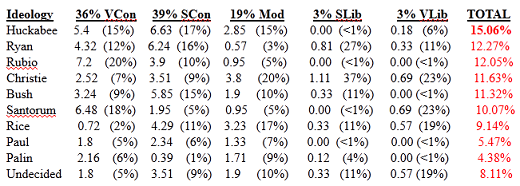
The Republican field in 2016 looks wide-open for the moment, according to Public Policy Polling (D). In newly released polls of Iowa, New Hampshire, and Florida,  politicos ranging from Mike Huckabee, to Chris Christie, to Jeb Bush come out at the top of the pack. With the Iowa Caucuses just three years away, lets take a look at some different turnout scenarios based on past exit polling. The information below provides a more detailed look at the Iowa PPP results, extrapolated from their ideological I.D. findings.

PPP results extrapolated from Ideological I.D. findings:
"VCon"= very conservative; "SCon" = somewhat conservative; "Mod" = moderate; "SLib" = somewhat liberal; "VLib" = very liberal