Showing posts with label Marco Rubio. Show all posts
Friday, March 4, 2016
No, Trump Is Not Unusually Strong Among Democrats - But He IS Unusually Weak Among Republicans
From Mitt Romney's past dalliance with government healthcare and abortion, to John McCain's involvement with campaign finance and immigration reform, strict purity to conservative orthodoxy has never been a Republican prerequisite for the presidential nomination. But if Romney and McCain flirted with expanding the bounds of acceptable disobedience to GOP principles, Donald Trump has blown the lid off those bounds.
It started before he even officially entered the race last June, when Trump implored attendees at a Republican summit in April to resist reforming Social Security and Medicare. During the first GOP primary debate on August 6, 2015, Trump expressed admiration for Canada and Scotland's single-payer healthcare system. A few days later, Trump defended Planned Parenthood during an interview with Sean Hannity. Two weeks later, Trump suggested during a CNN interview that he would raise taxes on wealthy Americans, cleverly labeling it a hedge-fund tax. The following month, Trump signaled his disdain for free trade during a '60 Minutes' interview, telling Scott Pelley NAFTA has been a "disaster." Believe it or not, the list goes on, but I digress.
Naturally, the historical nature of a Republican's brazen appeals to populist economic programs often identified with progressives led many political commentators to entertain an interesting theory: might Mr. Trump's overtures to the left pay dividends this November? Articles from Breitbart's Mike Flynn and The Washington Post's Philip Bump highlight Trump's support from a specific kind of Democrat - namely, ex-Democrats. The NY Times' hypothesis was a bit different, though not far off - a big chunk of Trump's support stems from self-identifying Republicans who, for whatever reason, are registered Democrats.
Regardless of the theory, beware of misleading headlines suggesting Trump could coast to victory in November on the backs of Democrats; because from the standpoint of general election polling, nothing appears nearly so out-of-the-ordinary. In fact, considering the eight national general election polls (with readily available crosstabs) conducted since the Iowa Caucus on February 1, Trump earns an average of just 9% from self-identified Democrats - essentially the same amount won by his GOP opponents Marco Rubio (9%) and Ted Cruz (8%). In fact, Mitt Romney, John McCain, and George W. Bush all polled better among Demo.crats than Trump during a similar period in their respective 2012, 2008, and 2004 (uncontested) primaries.
Not only that, but it's Marco Rubio - not Donald Trump - who holds Clinton to her lowest share of the Democratic vote. She wins, on average, 84% of Democrats in post-Iowa general election polling, while winning 85% and 86% against Donald Trump and Ted Cruz, respectively. See the table below:
Friday, August 2, 2013
Paul Ryan: Beloved By Republican Primary Voters, But Not Their Pick For President
![]() |
| Rep. Paul Ryan is the most popular of all 2016 Republican Presidential candidates in terms of favorability, but lags in horse-race polling. |
Congressman Paul Ryan, the young, wonky, slightly-awkward Wisconsin Congressman and most recent Republican Vice Presidential nominee has had his ups and downs since the start of the 2012 Presidential cycle. After what were surely flattering entreaties from his party to enter the race for the White House that year, he was picked from a large and impressive line-up of Republican politicians as one-half of the Presidential ticket with Mitt Romney.
Despite a close race, the Romney-Ryan ticket lost to Obama-Biden by a disappointing 51-47%. Both men appeared shell-shocked.
The undeniable disappointment on behalf of Republican voters and punditry at the result took a slight toll on the House Budget Committee Chairman's personal popularity. He saw a net positive favorability rating pre-2012 election turn negative afterwards.
In the 13 national surveys of Ryan's favorability since November 2012, only four of them found him with a higher favorable than unfavorable percentage. Since November 2012, he averages a 39% favorable rating, and a 41% unfavorable rating.
But while Ryan may need a little rehabilitation on his image with general election voters before running for President (which he has not ruled out), he's as beloved as ever by Republican primary voters, as a recent Pew Research poll made clear:
According to Pew, 2/3 of Republicans and Republican leaners view Ryan favorably, putting him in a very comfortable position when compared to other likely 2016 GOP contenders (Rand Paul is viewed favorably by just over half of Republicans, Marco Rubio by half, and Chris Christie by 47%).
Fortunately for Ryan, the Pew finding showing him the most popular 2016 GOPer is replicated in ALL TEN post-2012 election surveys of Republicans and/or GOP primary voters. In every single survey, Ryan's favorability score exceeds all other Republicans.
The data in the table below shows the average favorability rating of every potential major 2016 GOP primary candidate since the 2012 election:
![]() |
| All surveys used in the averages can be found here. |
For whatever reason (which must at least partially include name recognition), Ryan leads a pretty impressive list of potential candidates in terms of favorability, while the nationally popular Chris Christie ranks 2nd to LAST, behind the uber-socially conservative Rick Santorum, and the humiliated Rick Perry.
That's why some might be surprised to learn that despite all the love from his party, Ryan's not performing all that well in the early 2016 primary horse-race. In fact, in an average of all primary surveys since the presidential election, Ryan finishes third, behind Marco Rubio and Chris Christie:
Sunday, July 28, 2013
Democratic Pollster finds 2016 Republican Candidates Nipping At Hillary's Heels
![]() |
| Photos courtesy of Donkeyhotey |
Despite signs of shocking strength in Public Policy Polling 2016 state surveys earlier this year, the unquestionable front-runner for the Democratic nomination is seeing less success at a national level, especially considering the most recent numbers from the left-leaning NC based pollster:
So Gov. Chris Christie, fmr. VP nominee Paul Ryan, and President Bush's brother Jeb are all essentially tied with Hillary Clinton. Marco Rubio is within the margin of error, and Rand Paul is within 10 points of her.
What's going on here? I thought Hillary was unstoppable, poised to not only win by double digits in the general election against all of her potential opponents, but poised to start picking off traditionally red states in a fashion not seen since the '84 Reagan landslide.
In fact, just as recently as May, PPP found a considerably stronger Hillary Clinton that led Marco Rubio and Rand Paul by double-digits, and Chris Christie by 3 points. And in PPP's first 2016 poll from January, Clinton led Jeb Bush and Paul Ryan by 14 points. See the chart below:
But the most recent PPP poll is notable not simply because of how well the Republican candidates perform against Clinton relative to previous PPP surveys, but also how they perform relative to all other 2016 polling to date:
Marist was the last non-PPP pollster to survey the 2016 Presidential race, and they did NOT find any of the Republican candidates tied with Clinton. Christie only managed 41% to Clinton's 47%. And it only gets worse from there for the rest. Paul Ryan, who trailed Hillary Clinton by just two points in the PPP poll, finds himself a whopping 16 points behind the Democratic frontrunner. Jeb Bush trailed Hillary by a 8 points (as opposed to 3 points in the PPP poll), and Rubio, Paul, and Perry were all down double digits.
Quinnipiac found similar results in late June and May, with Christie down 6 to Clinton, Bush down 8, and Paul down double-digits. And as far back as March, Quinnipiac had Clinton ahead of Christie by 8, Ryan by 12, and Rubio by 16. So as you can see, the recent PPP numbers represent quite a shift from the start of the year.
Pulling back the curtains on the poll results, we see some interesting racial splits among various 2016 match-ups. For example, NONE of the GOP candidates perform as well with white voters as Romney did in 2012, when he defeated Obama 59-39%. In fact, only Chris Christie and Paul Ryan manage to win whites by double digits against Hillary (by 12 and 11 points, respectively), lending credence to the notion advanced by some that Republicans will have trouble repeating their 2012 performance with white voters against a Democrat who is not an African American. Also notable is the fact that Hillary Clinton is able to keep Rand Paul limited to a 6 point advantage (46-40%) among white voters.
Wednesday, March 27, 2013
Hillary Tops 70% With Moderates Against Home-Stater Marco Rubio In Recent Florida Poll
![]() |
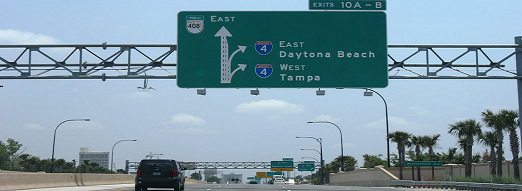
| The I-4 Corridor, which runs West-to-East across the Florida peninsula, connecting Orlando and Tampa, is one of the most sought after swing-regions within a "swing-state" in the country. |
As I wrote yesterday, Public Policy Polling has a new 2016 poll on the perennial swing-state of Florida. But their swing-state status won't look all that "perennial" if Hillary Clinton has anything to say about it. She leads 3 likely 2016 GOP contenders, former VP nominee Paul Ryan (54-41%), ex-Gov. Jeb Bush (53-40%), and Sen. Marco Rubio (56-40%), demolishing them among Independent AND Moderate voters.
Yes, Hillary Clinton leads two reasonably popular HOME-STATE politicians...by double digits...in a state that hasn't seen a presidential candidate win by such a margin since 1988 (and even then, it was a Republican that accomplished the feat).
If PPP's results are actually borne out, Hillary would far outpace her husband's 48-42% victory over Bob Dole in 1996, the highest winning margin of any Democrat in Florida since exit polling became easily available in 1976. She would make Obama's back-to-back 50-49% & 51-48% wins in 2012 & 2008 look like the work of a political amateur. Her margin over the 3 Republicans in Florida looks the most similar to Ronald Reagan's performance in the state in 1980 (which he captured from Jimmy Carter, 56-39%).
To better understand the significance of a potential double-digit Florida win for Hillary, consider the chart below of Florida presidential election results since 1976:
Where exactly does Hillary's peculiar strength in such a quintessential swing-state stem from? The PPP cross tabs have her winning around 85% of self-identified "liberal voters," pretty close to Obama's numbers in the state against Romney last November. She manages about 20% of the "conservative" vote, also similar to Obama's 2012 margin.
Nothing in particular stands out until you glance at the vote break-down of "moderates." Hillary doesn't just beat the GOP. She wipes the floor with them:
- She's +47% with moderates in a hypo against Paul Ryan (69-22).
- She's +30% with moderates in a hypo against Jeb Bush (61-31).
- She's +48% with moderates in a hypo against Marco Rubio (71-23).
Monday, March 25, 2013
Moderate voters skew HEAVILY Democratic in PPP's 2016 polling
I consider myself to be pretty moderate on a number of policy issues, mostly social: abortion, immigration, gay marriage, the death penalty, separation of church and state. But if I were asked by an exit pollster my "ideology" on a scale of very conservative, somewhat conservative, moderate, liberal, or very liberal, I'd probably put myself in the somewhat conservative side of things. My views on taxation and the role of government in the economy shove me to the right. But there's a significant portion of the country that identifies their political ideology as "moderate" (41% to be exact). Who are these so-called "moderate voters" that typically make up the plurality of the presidential electorate, and how do they vote? Even more importantly, how will they vote in 2016?
If early Public Policy Polling surveys on 2016 are any indicator, Republicans will be STOMPED by Democrats among "moderates." In fact, the GOP is poised to win the LEAST amount of so-called "moderate voters" ever (or at least since exit polling began in 1976), especially if Hillary Clinton is their nominee. The chart below documents the moderate vote for Hillary Clinton vs. any GOP opponent in every national or state 2016 poll conducted by PPP over the last month. Unfortunately, the very few polling firms besides PPP that have already started surveying the 2016 race did not provide crosstabs for ideological breakdown. So the focus will be on PPP's results:
If you operate under the assumption that Conservatives vote Republican, Liberals vote Democrat, and Moderates split their vote, you'd be wrong, according to PPP...dead wrong. Hillary Clinton leads Paul Ryan, Chris Christie, Marco Rubio, Jeb Bush, Rick Santorum, Bobby Jindal, Newt Gingrich, and Scott Walker among moderates in every state & nat'l poll over the last month, by MASSIVE margins. In fact, the best that any Republican is able to do against Hillary among moderates is Paul Ryan's 57-32% deficit in the state of Pennsylvania. But even then, Hillary leads by 25 points. The WORST any Republican does with moderates is Marco Rubio in Michigan AND his home-state of Florida. Hillary leads him with moderate voters in both states, 65-16% and 71-23% respectively. That's border-line embarrassing for Rubio. To make it worse, Hillary has averaged a 63-25% lead over Republicans with moderates in PPP polling over the last month.
Monday, March 11, 2013
Key Takeaway for Republicans from Quinnipiac 2016 poll: Pray Hillary doesn't run
![]() |
| Demographic realities provide Hillary (and Democrats generally) with advantages in 2016. Photos courtesy of hillaryclintonoffice.com, & Reuters/AP. |
*numbers in parentheses indicates the results of a February 3rd, 2013 Public Policy Polling survey4. If the election for President were being held today, and the candidates were Hillary Clinton the Democrat and Christopher Christie the Republican, for whom would you vote?
Hillary Clinton - 45% (46)
Chris Christie - 37% (42)
Don't know/other - 19% (12)
5. If the election for President were being held today, and the candidates were Hillary Clinton the Democrat and Marco Rubio the Republican, for whom would you vote?
Hillary Clinton - 50% (49)
Marco Rubio - 34% (41)
Don't know/other - 16% (10)
6. If the election for President were being held today, and the candidates were Hillary Clinton the Democrat and Paul Ryan the Republican, for whom would you vote?
Hillary Clinton - 50% (50)
Paul Ryan - 38% (44)
Don't know/other - 12% (6)
Despite being 4 years out from the election, those are some rough numbers for the GOP, especially considering that Chris Christie and Paul Ryan are fairly well-known nationally, courtesy of Hurricane Sandy and a vice presidential nomination. Of the 3 Republicans tested, it's Paul Ryan who actually scores the highest level of national support (at 38%). The only problem with that is the fact that he elicits stronger support for Hillary Clinton, who comes in at 50%. So Ryan would essentially need to win all 12% of the voters who are undecided at this stage just to match Hillary. While Chris Christie attracts slightly less nationwide support than Paul Ryan (37%), he is able to hold Hillary well under 50%. Perhaps even more interesting, nearly 1 in 5 voters say they would be undecided on a Clinton v. Christie 2016 race. Marco Rubio, unsurprisingly, performs the worst against Clinton, only garnering 34% to her 50%. He is not as well known as Christie or Ryan, and his limited foray into the national spotlight will largely be remembered for this (as trite as it may be).
Unfortunately, it only looks worse for the GOP trio after peering at the Quinnipiac crosstabs. With all the talk of the GOP's demographic troubles, I decided to check out the ethnicity breakdown of the poll sample. 73% of respondents identified as white, 11% as black, 9% as Hispanic, and 7% as Asian/other. Compared to the 2012 election, Quinnipiac is finding registered voters to be more white and less minority. The only problem with that is the fact that white voters have declined as a percentage of the electorate in every election since 1992:
Not only that, but Latino's (a group Obama won in 2012 by a 71-27% margin) have gained in numbers every year since 1992. The African American portion of the electorate was largely static from 1980-2008, when it jumped based on enthusiasm for the first black presidential nominee. The purpose behind all this information is to illustrate that despite Quinnipiac poll findings, the electorate is very unlikely to see an increase in the white vote from 2012, and equally unlikely to see a decrease in the Hispanic vote. In fact, some have even suggested white turnout could drop to under 70% in 2016. Just for fun, what would the Quinnipiac results have looked like with white voters making up less than 70% of the electorate? The below chart illustrates what happens using a racial make-up of 69% white, 12% black, 12% Latino, 7% Asian/other.**
Wednesday, February 20, 2013
HILLARYLAND: Early In 2016 Race, PPP Finds A Nearly Invincible Hillary Clinton
In 2008, Barack Obama carried 365 electoral college votes against John McCain, roughly on par with the 379 electoral college votes Bill Clinton carried against Bob Dole in 1996, and 1 of the largest electoral college victories since George H. W. Bush trounced Michael Dukakis in 1988, 426-111.
But according to Public Policy Polling (D), when voters are given Hillary Clinton as a hypothetical presidential choice for 2016, she would win in a landslide at least larger than Obama's in 2008 and her husband's in 1996, and at most, would rival FDR, Richard Nixon, and Ronald Reagan for 1 of the largest landslides in history.
A string of recent 2016 polling from the prolific Democratic pollster indicates that Hillary Clinton would be, by far, the Democrat's strongest candidate in a generation. In states as traditionally conservative as Alaska, Texas, Kentucky, Louisiana, and Georgia, Hillary would tie OR defeat every single one of her potential Republican rivals. This fact is far more astounding when you consider that Barack Obama lost all five of these deep-red states in both 2008 and 2012, by no less than 8 points (in Georgia), and no more than 23 points (in Kentucky). Furthermore, Kentucky & Louisiana have not voted Democratic since 1996, Georgia since 1992, Texas since 1976, and Alaska since 1964.
But just for fun, let's assume Hillary Clinton wins every state Obama won in 2012 (for a total of 332 electoral college votes), as well as the five additional deep-red states PPP finds Hillary performing well in:
That puts Hillary's ECV total at 389, to 149 for her hypothetical Republican opponent (the lowest ECV total for a Republican since Barry Goldwater in 1964!). But really, if PPP is correct regarding their red-state, 2016 polling, what are the odds that Hillary Clinton would win AK, TX, KY, LA, & GA, but lose other less Republican states, such as North Carolina, Indiana, Missouri, or Arizona? Quite slim. The below map takes a look at how many states Hillary Clinton could win in the event she wins every state Obama lost in 2012 by 14 points or less (the margin by which Obama lost Alaska, one of the five red states where PPP finds Hillary Clinton defeating her likely Republican opponents):
Tuesday, January 15, 2013
Hillary's favorability takes a hit, and Chris Christie's her most formidable 2016 opponent (PPP)
In a survey taken January 3-6, 2013, Clinton clocks in with an impressive natonal favorable/unfavorable rating of 54/39% (+15 pts), but that's down from PPP's previous survey in December that measured her at 57/36% (+21 pts), and significantly down from the 65+% ratings she enjoyed throughout much of 2012. In fact, her January PPP rating is the lowest measured by any polling firm since last April. Below is a chart of Hillary Clinton's national favorability rating since 2011, according to Talking Points memo, The Argo Journal, and assorted polling:
Friday, December 21, 2012
Rubio leads 2016 field in first outing from Harper Polling (R)
Harper Polling is a new Republican firm designed to be the GOP's answer to the well-known Public Policy Polling (D). Politico recently did a piece on the new group regarding the Democratic edge in the polling and data departments. Well, it seems they're already up and running, as they've released their first numbers regarding the 2016 Republican primary:
Marco Rubio: 34%
Chris Christie: 18%
Condoleeza Rice: 14%
Rand Paul: 8%
Allen West: 5%
Scott Brown: 3%
Undecided: 18%
Rubio leads the pack, confirming the PPP poll from two weeks ago that had Rubio ahead, albeit by a much smaller margin. Though the likely reason for the large disparity is in the candidates that were polled. Harper Polling included a few unconventional candidates in exchange for likely candidates like Paul Ryan, Jeb Bush, or Rick Santorum. PPP only polled likely candidates.
PPP results from 12/6/2012:
Rubio: 18%
Christie: 14%
Bush: 12%
Ryan: 12%
Huckabee: 11%
Rice: 8%
Palin: 7%
Rand Paul: 7%
Santorum: 4%
Other/Undecided: 7%
*Note Rick Santorum is in last place. That's a precarious position for the runner-up to the 2012 GOP nomination, as I wrote about here.
From Harper Polling, regarding the 2016 poll:
Rubio is strongest in the South and West. There’s some logic in that. He’s a son of the South, for those who count Florida as the South. The Hispanic appeal may run a bit stronger out West. In the Northeast, he and Christie run virtually tied at 29-27%. The Midwest may ultimately be the harder nut to crack for Rubio. His working class background may be his strongest connection to the industrial Midwest.
The Chris Christie primary voter appears to lean more toward the middle. Along with Condi Rice, his voters are more likely to support exceptions to the no-new-taxes pledge and they believe that compromise is better for the country. They are less likely to watch Fox News and support TEA party goals.
Speaking of the TEA party. It is the foundation of Rubio’s support. Approaching half of all TEA supporters (43%) are voting for him. If I’m one of the other guys, it can’t stay that way. Somebody has to eat away at that base for Rubio.
Wednesday, December 12, 2012
Hillary Clinton (and Ashley Judd!) shockingly strong in DEEP red Ky., per PPP
The result, according to PPP President Dean Debnam, shows just how competitive Democrats could be for the third presidential election cycle in a row:
Subscribe to:
Posts (Atom)